



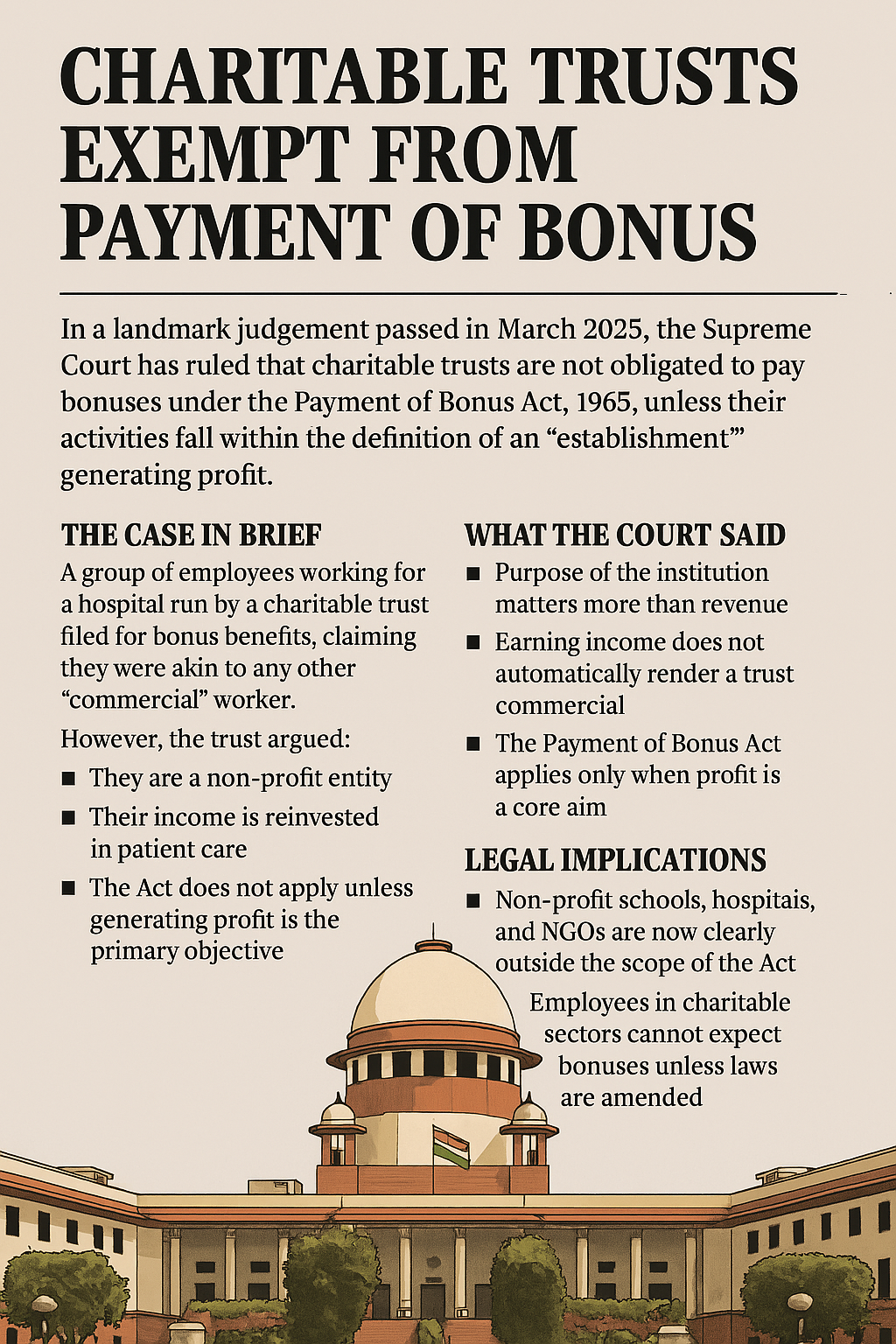
The Payment of Bonus Act, 1965
The Payment of Bonus Act, 1965
Background and Purpose
The Payment of Bonus Act, 1965 was enacted by the Indian Parliament to provide for the payment of bonuses to employees in certain establishments based on the profits or productivity of the company.
The Act ensures that employees receive a fair share of the profits earned by the employer, fostering industrial peace and motivating workers. It also addresses the economic disparity between employers and employees by mandating a minimum bonus irrespective of the employer's profits.
Objectives of the Act
To mandate payment of bonus to employees in certain factories and establishments.
To provide minimum and maximum limits on bonus payments.
To ensure employees get a fair proportion of profits or productivity gains.
To promote industrial harmony by providing a statutory right to bonus.
To regulate the calculation, payment, and recovery of bonuses.
Applicability
The Act applies to every factory and establishment employing 20 or more persons (as per latest amendments, threshold may vary).
Includes factories, industries, establishments engaged in any business, trade, or service.
Both permanent and temporary employees may be covered, subject to conditions.
Certain categories like managerial staff or employees drawing above a specified salary may be excluded.
Key Provisions
1. Eligibility for Bonus (Section 8)
Employees who have worked for a minimum period (usually 30 working days in the accounting year) are eligible.
Excludes employees who earn above a specified salary ceiling.
Employees must be on the payroll on the relevant date.
2. Minimum and Maximum Bonus (Sections 11 & 12)
Minimum bonus payable is 8.33% (1/12th) of the salary or wages earned during the accounting year.
Maximum bonus payable is 20% of such salary or wages.
The bonus is calculated on the salary or wage earned during the accounting year (generally 12 months).
3. Calculation of Bonus (Section 10)
Bonus is linked to the available surplus or allocable surplus of the employer.
If the employer makes profits, bonus is payable proportionate to profits but subject to minimum and maximum limits.
In case of no profits, minimum bonus still payable (subject to government notification).
4. Set-Offs and Recovery (Sections 14 & 15)
Employers can set off any amount paid as bonus under other laws or agreements.
Employees cannot claim bonus beyond statutory limits.
5. Inspection and Enforcement (Sections 17-22)
Government-appointed inspectors can ensure compliance.
Penalties apply for failure to pay bonus.
Significance of the Act
Provides statutory entitlement to employees for bonus payments.
Ensures equitable sharing of profits between employer and employees.
Promotes industrial peace and motivation.
Protects workers’ rights and limits arbitrary denial of bonuses.
Relevant Case Laws
Case 1: Tata Engineering and Locomotive Co. Ltd. v. Their Workmen (1969)
Issue: Whether bonus is payable to employees during periods of layoff or strike.
Held: The Supreme Court held that employees are entitled to bonus for the actual days worked. Periods of layoff without wages do not count.
Significance: Clarified bonus calculation basis on actual attendance and wages.
Case 2: Steel Authority of India Ltd. v. National Union (1986)
Issue: Whether employees drawing above the salary ceiling are entitled to bonus.
Held: The court upheld the salary ceiling and ruled that employees earning above the prescribed limit are not eligible.
Significance: Affirmed exclusion of higher-paid employees from bonus scheme.
Case 3: Bharat Petroleum Corporation Ltd. v. Workmen (2001)
Issue: Whether contract and temporary employees are eligible for bonus.
Held: The court held that if contract or temporary employees fall within the definition of employee under the Act, they are eligible.
Significance: Expanded the scope of eligible employees under the Act.
Relation to Other Laws
The Act operates alongside Factories Act, 1948, Industrial Disputes Act, 1947, and Minimum Wages Act, 1948.
It complements Industrial Employment (Standing Orders) Act, 1946 by promoting fair treatment.
Bonus payments under this Act cannot be waived or substituted by other benefits unless allowed by law.
Summary
| Aspect | Details |
|---|---|
| Purpose | Statutory payment of bonus to employees |
| Applicability | Factories/establishments with 20+ employees |
| Eligibility | 30 days work minimum; salary ceiling applies |
| Bonus Range | Minimum 8.33%, Maximum 20% of salary/wages |
| Calculation Basis | Based on employer’s profits and employee’s salary |
| Important Cases | Tata Engg (1969), SAIL (1986), Bharat Petroleum (2001) |
| Relation to Other Laws | Works alongside labor and wage legislation |
RELATED Blog

















































































































































































































































































































































































































































































































































































































































































































































0 comments