


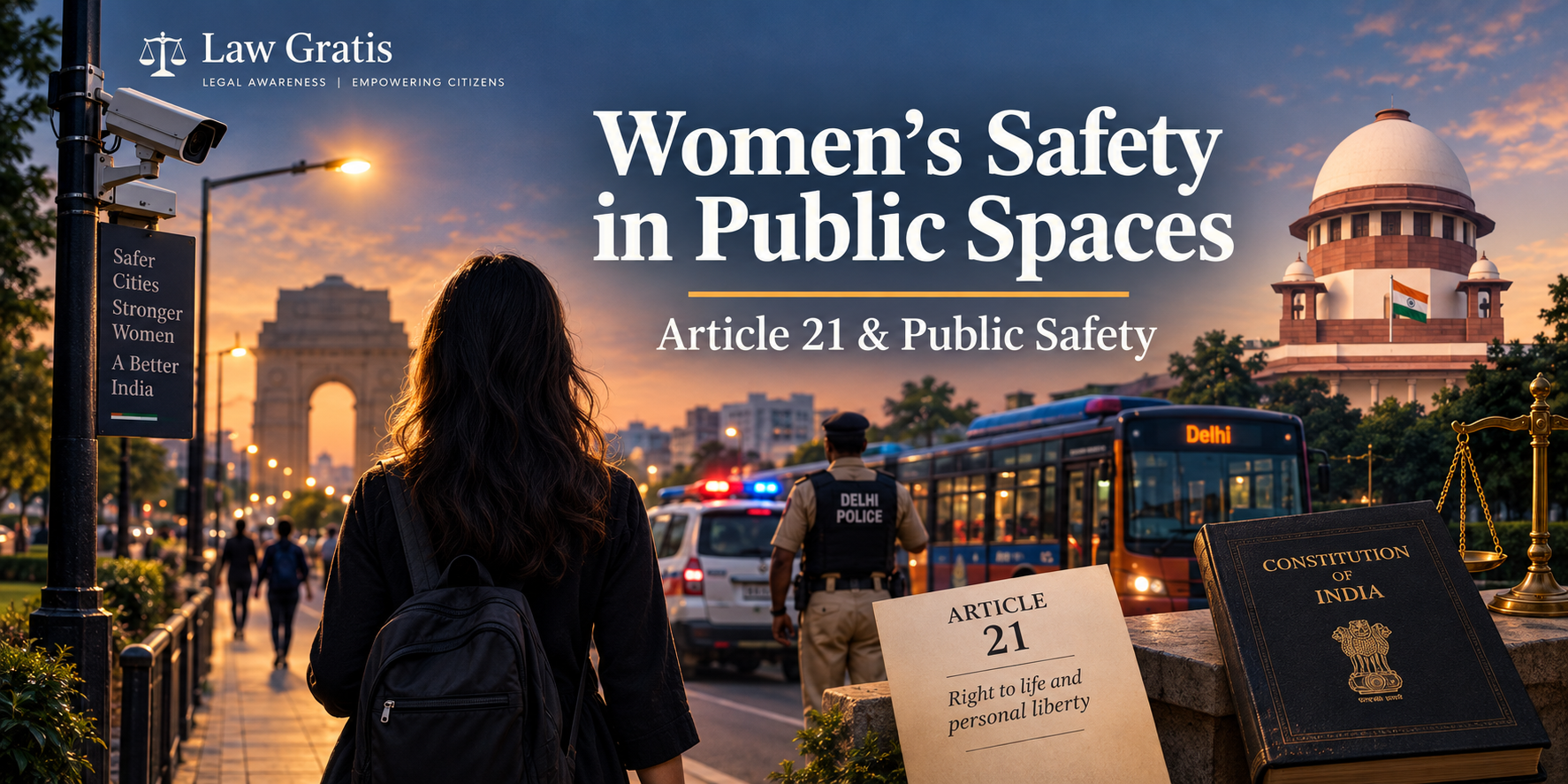

“Women’s Safety in Public Spaces: What the Recent Delhi-NCR Rape Cases Teach Us About Article 21”
Title : “Women’s Safety in Public Spaces: What the Recent Delhi-NCR Rape Cases Teach Us About Article 21”
1. Introduction and Background
Women's safety in public spaces is one of the most important constitutional and social issues in India today. Public spaces include parks, roads, footpaths, bus stops, metro stations, markets, colleges, workplaces and public transport. If women do not feel safe in these places, their fundamental rights become only on paper.
The Constitution of India guarantees Right to Life under Article 21 and Right to move freely under Article 19(1)(d). But if a woman has to think ten times before going out in the evening, if parents are scared to send their daughter to tuition, then what is the meaning of these rights?
Recently, Delhi-NCR again witnessed some brutal incidents of sexual assault against young girls. Taking note of newspaper reports, the Supreme Court on 28th September 2026 took suo motu cognizance in the matter titled In Re: Assault on Young Girls in Delhi-NCR. The Bench said that the issue is not only about punishing the accused in these three cases, but about checking whether our public safety system is actually working.
This case has again brought discussion on Article 21, State responsibility and women's right to live with dignity without fear.
2. Facts Noted by Supreme Court in Delhi-NCR Cases
Supreme Court specifically noted three incidents:
a) Gang rape of a 17 year old girl in Aastha Kunj Park, South Delhi.
b) Gang rape and murder of a teenage girl in Swaroop Nagar, Outer Delhi.
c) Sexual assault of a minor girl inside a moving sleeper bus coming from Greater Noida to Delhi.
The Court observed that all three incidents happened either in public places or in public transport which are supposed to be safe and monitored. The Court pointed out common failures - poor street lighting, CCTV not working or not installed, no regular police patrolling, isolated parks, and lack of verification of drivers and staff of private buses.
At the same time, the Supreme Court clarified that the guilt of the accused will be decided by trial court after proper investigation under BNSS, 2023 and evidence under BSA, 2023. The Supreme Court is not conducting a trial, but looking at larger systemic issue.
3. Meaning and Scope of Article 21
Article 21 says: "No person shall be deprived of his life or personal liberty except according to procedure established by law."
In the initial years, Article 21 was understood narrowly. But after the Maneka Gandhi case, the Supreme Court gave a wide meaning.
Important judgments expanding Article 21:
- Maneka Gandhi Vs Union of India, 1978: Procedure must be fair, just and reasonable, not arbitrary.
- Francis Coralie Mullin Vs Administrator, Delhi, 1981: Right to life does not mean mere animal existence, it means right to live with dignity.
- Vishaka Vs State of Rajasthan, 1997: The right to work with dignity and safety for women is part of Article 21. Employers and the State must ensure a safe environment.
- Nirbhaya case - Mukesh Vs State, 2017: The court said safety of women is essential for enjoying Article 21.
So if a woman cannot go to park, cannot travel in bus at night, cannot walk on road freely due to fear of sexual assault, then her right to live with dignity and personal liberty is directly affected. Fear itself is a violation of liberty.
4. Positive Obligation of State
Under Constitution, State has two types of duties:
- Negative duty - The State itself should not take life illegally.
- Positive duty - The State must create conditions where life can be enjoyed safely.
Public safety is the primary duty of the State. Police, Municipal Corporation, PWD, Transport Department, Delhi Development Authority - all have a duty to maintain infrastructure which makes spaces safe.
The Supreme Court said every crime does not mean the State has violated Article 21. A criminal act is done by the accused, not by the State. But if the State fails to provide basic safety measures like lights, CCTV, patrolling, and a safe transport system, then it shows a failure of its constitutional obligation.
In this suo motu case, Supreme Court is examining whether preventive frameworks made after Nirbhaya case like Safe City Project, Nirbhaya Fund, Emergency Response Support System (112), panic buttons in buses are actually implemented on ground or only exist in files.
5. Why Public Spaces Become Unsafe - Root Causes
Court and various studies show many reasons:
a) Lack of Infrastructure: Many parks in Delhi have no lights, broken boundary walls, bushes not cut. Bus stops are isolated. CCTV cameras are installed but not working, or no one monitors footage.
b) Lack of Effective Policing: Beat policing is weak. PCR vans not seen in interior areas. Women police are less in night patrolling. Response time of 112 is high in some areas.
c) Unsafe Public Transport: Private sleeper buses, Gramin Seva, e-rickshaws have no verification of staff. No GPS, no panic button. In the sleeper bus incident, how a minor girl was assaulted in a moving bus shows complete absence of monitoring.
d) Social and Cultural Reasons: Patriarchal mindset, victim blaming, eve-teasing considered normal. People don't intervene when they see harassment. Lack of gender sensitization.
e) No Accountability: After every incident, an FIR is registered, accused arrested. But no one asks - who was responsible for maintenance of that park? Was SHO doing night patrolling? Was the transport department checking buses? Without fixing accountability, the system does not improve.
6. Directions Given by Supreme Court in Present Case
Supreme Court has asked for detailed reports:
1. From Delhi Police, Delhi Government, Union Home Ministry on existing safety measures in parks, roads, markets, schools, public transport.
2. Audit report of street lights and CCTV - how many working, how many not working.
3. Vulnerability mapping - which areas are crime prone for women and what special measures taken there.
4. Use of National Database on Sexual Offenders (NDSO) - how many offenders tracked, how police use databases to prevent crime.
5. Status of implementation of Safe City Project in Delhi.
6. Safety measures in private buses - GPS, panic button, verification of staff.
7. Appointed Senior Advocate Liz Mathew as Amicus Curiae to assist court and suggest measures.
The court gave 4 weeks time for filing reports and said it will monitor implementation.
7. Connection with Article 14, 15 and 19
Women safety is not only an Article 21 issue, but also an equality issue.
Article 14 - Right to Equality: If women cannot equally enjoy public spaces like men due to fear, it violates equality. Equal access to park, road, and transport is part of equality.
Article 15(3) - Special Provision for Women: Constitution itself allows the State to make special provisions for women and children. So measures like women helpline 181, pink police booths, women PCR, reservation of seats in buses, all-women police stations are constitutionally valid and in fact required.
Article 19(1)(d) and 19(1)(g): Right to move freely throughout India and right to practice any profession. If public spaces are unsafe, women cannot move freely and cannot work in night shifts. Many BPOs, hospitals, factories face this problem.
So the Supreme Court said safety is essential for overall personality development and participation of women in public life.
8. Role of New Criminal Laws - BNS, BNSS, BSA
India has now three new criminal laws from 1st July 2024:
- Bharatiya Nyaya Sanhita, 2023 (BNS): Section 63 defines rape, Section 70 gang rape, strict punishment up to death in some cases. Section 74 to 79 deal with assault and harassment.
- Bharatiya Nagarik Suraksha Sanhita, 2023 (BNSS): Provides for Zero FIR, e-FIR, time bound investigation (Section 193), victim's statement by woman magistrate, protection of victim identity.
- Bharatiya Sakshya Adhiniyam, 2023 (BSA): Provides for electronic evidence, presumption in rape cases.
But the Supreme Court observed that only making strict punishment after crime is not enough. Criminal law is reactive. What we need is a preventive system.
We need 5 pillars model:
1. Good Law on paper
2. Effective and sensitive policing
3. Safe infrastructure - lights, CCTV, safe buses
4. Public awareness and bystander intervention
5. Accountability of officials if safety measures not maintained
Without these 5 pillars, even strictest law will fail.
9. Police Accountability and Institutional Liability
Earlier, after every rape case, focus was only on arrest and punishment of accused. Now the Supreme Court is shifting focus to institutional liability.
Questions being asked:
- Who was responsible for the light in that park?
- Was CCTV footage checked daily?
- Did a beat constable visit that area?
- Did the transport department verify bus staff?
If negligence is found, departmental action should be taken. The Supreme Court said saying "sorry" after an incident is not enough. There must be measurable action on ground.
This concept is already there in law of torts and in cases like Nilabati Behera Vs State of Orissa, 1993 where the State was held liable to pay compensation for failure to protect life.
10. Conclusion and Suggestions
Delhi-NCR incidents show that Article 21 will remain only a slogan if women cannot go to college, office, market safely.
The real meaning of Right to Life is Right to Fearless Life. For that we need practical steps:
- Regular audit of lights and CCTV by third parties.
- 100% GPS and panic button in all public and private buses with a central control room.
- More women police and pink booths in vulnerable areas.
- Use of the NDSO database to track repeat offenders.
- Community policing and RWAs involvement.
- Gender sensitization in schools and for police.
The Supreme Court suo motu case is a welcome step. It shows the judiciary is acting as guardian of fundamental rights. But ultimately, safety will come only when laws are implemented honestly, police are accountable, and society changes its mindset.
The Constitution does not only promise life, it promises dignified, safe and equal life to every woman in public spaces.
Women’s safety is not only a criminal-law issue; it is also a constitutional responsibility. Awareness of legal rights, effective reporting and accountable public institutions are essential for creating safer public spaces.
Author Profile
Ragini Mani Tripathi
B.A.LL.B. 7th Semester
Manu Law College
Interested in Legal Research and Criminal Law
RELATED Blog



comments