


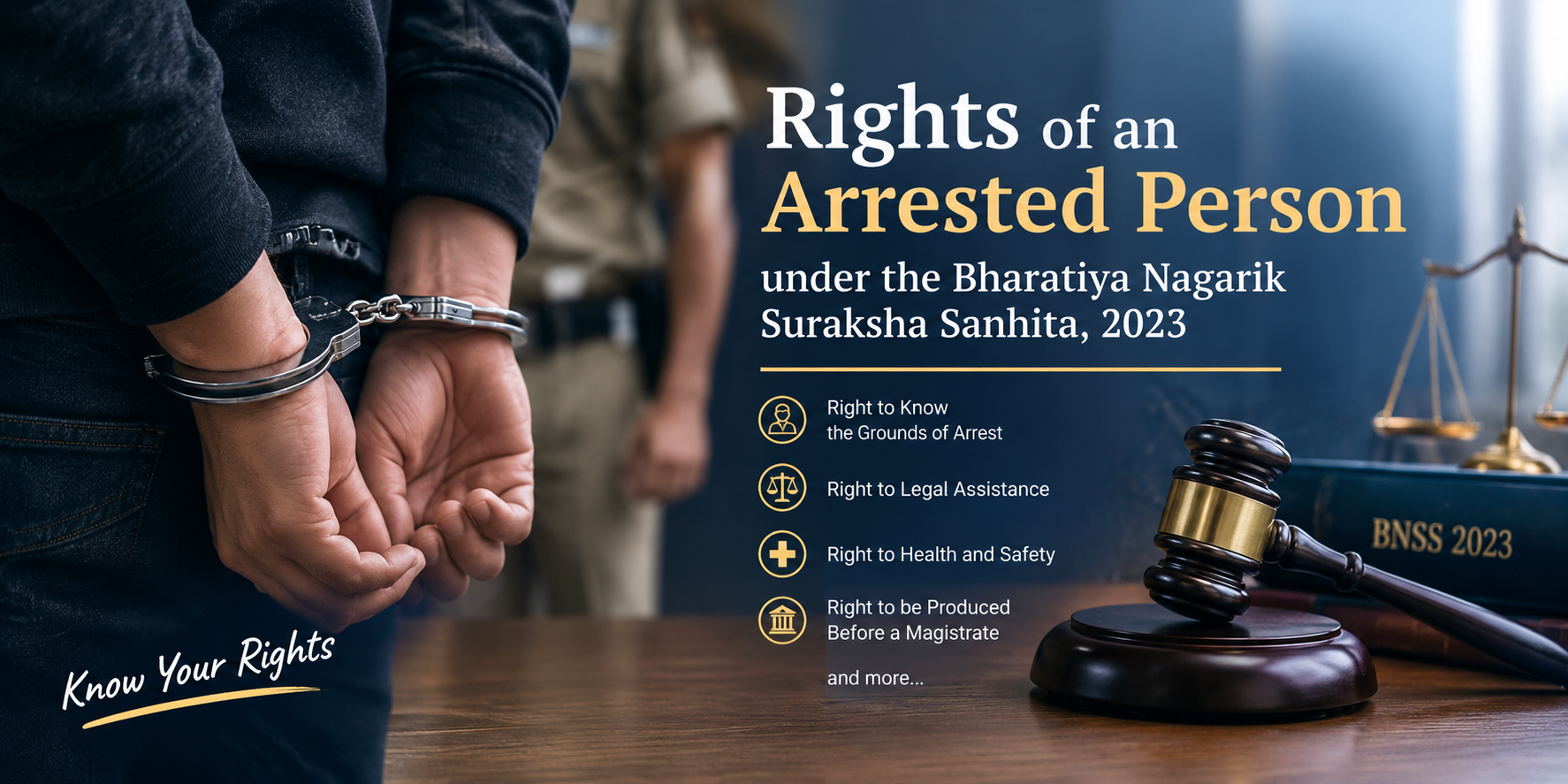

Rights of an Arrested Person under the Bharatiya Nagarik Suraksha Sanhita, 2023
Outline:
1.Introduction
2.Meaning of Arrest
3.Right to Know the Grounds of Arrest
4.Right to Inform a Relative or Friend
5.Right to Legal Assistance
6.Right to Health and Safety
7.Right to be Produced Before a Magistrate
8.Protection Against Unlawful Detention
9.Important Supreme Court Cases
10.Importance of These Rights
11.Conclusion
Title: Rights of an Arrested Person under BNSS, 2023
Introduction
Police have power to arrest, but arrest directly attacks Article 21 - Right to Life and Personal Liberty.
Bharatiya Nagarik Suraksha Sanhita, 2023 (BNSS) replaced CrPC and has made rights of arrested persons more strong. Law says - _Innocent till proven guilty, so arrest must be legal, justified and with full protection.
These rights are not just in BNSS, they are also given in the Constitution of India (Article 22) and protected by the Supreme Court.
Main Rights of an Arrested Person - Section wise
1. Right to Know Grounds of Arrest - Section 47 BNSS
Police must tell clearly in writing why you are arrested.
If an arrest is with a warrant, a warrant must be shown. Without knowing the reason, you cannot take bail or lawyer. Arrest without reason is illegal.
2. Right to Inform Family / Friend - Section 48 BNSS
As soon as you are arrested, police must immediately inform your relative, friend or any person nominated by you. Police will also inform you where you are kept. This is to stop illegal and secret detention.
3. Right to Meet an Advocate - Article 22(1) & Sec. 38 BNSS
Every arrested person has the right to consult a lawyer of his choice. The police cannot stop you from meeting your advocate. This right starts from the moment of arrest.
4. Right to Health, Safety and Dignity - Section 56 BNSS
The person having custody of the arrested person must take reasonable care of his health and safety. Beating, torture, and ill-treatment is totally prohibited. This section protects physical and mental safety.
5. Right to Medical Examination - Section 53 & 54 BNSS
After arrest, the arrested person will be medically examined by a government doctor. This is very important proof of police torture in custody. If you are a woman, the medical exam will be done by a female doctor only.
6. Right to be Produced Before Magistrate within 24 Hours - Section 58 BNSS
This is the Golden Rule. If arrest is without warrant, police must produce you before the nearest Magistrate within 24 hours. Police cannot keep you in lock-up for more than 24 hours without the Magistrate's permission. While producing, travel time is not counted.
7. Right Against Illegal Detention - Article 22(2)
Beyond 24 hours, detention is illegal unless the Magistrate gives custody. This prevents police from harassing any person.
8. Right of Free Legal Aid
If you are poor and cannot afford a lawyer, you have the right to get free legal aid from the District Legal Services Authority. The magistrate must inform you about this.
9. Right to Bail in Bailable Offence - Section 478 BNSS
If an offence is bailable, police must tell you that you have the right to get bail and bail can be given at the police station itself.
10. Rights of Women, Children and Sick Persons
- Women cannot be arrested after sunset and before sunrise except in exceptional cases with permission of the Magistrate.
- No male police can touch the body of a woman during an arrest.
- Handcuffing should not be done in a routine manner.
11. Arrest Must be As Per Procedure - Section 62 BNSS
Section 62 says arrest must be made only as per BNSS or any other law in force. Police cannot arrest in any illegal way.
Landmark Supreme Court Judgments - Must Remember
This is the Bible for arrest law. Supreme Court gave 11 mandatory guidelines:
- Police must wear name tags
- Prepare arrest memo signed by witness
- Inform relative of arrested person
- Medical examination every 48 hours
- Allow lawyer to meet
If police violate these, it will be contempt of court and police officers can be punished.
The court said - "The power to arrest is different from the need to arrest." Police cannot arrest just because they have power. Arrest should be justified, not routine. Police officers must show the reason why an arrest is necessary.
The Supreme Court said for offences punishable upto 7 years, police should not arrest directly. Police must give Notice under Section 35(3) BNSS [Old 41A CrPC]. This is to stop unnecessary arrests.
Why Are These Rights Important for the Common Man?
1. To protect personal liberty.
2. To stop custodial violence and torture.
3. To maintain balance between police investigation and human rights.
4. To give fair chance to arrested person to defend himself.
Arrest leaves lifetime stigma. So law gives protection that arrest must be last option, not first option.
Conclusion
BNSS, 2023 has made Indian criminal justice more human and fair. Every citizen must know these rights. If you are arrested or your family member is arrested, you can demand these rights. Remembering these sections can save you from illegal arrest.
Author: Ragini Mani Tripathi
http://B.A.LL.B. 7th Semester
Manu Law College
RELATED Blog



comments