


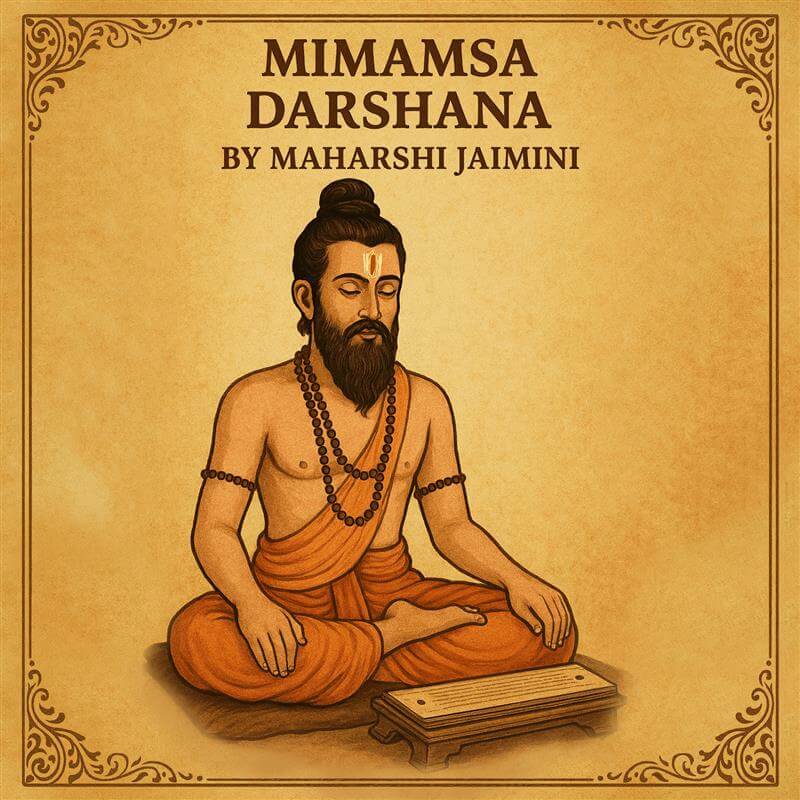

Philosophy of Mimamsa by Prabin Kumar Yadav (Medha Law and Partners)
- Introduction
Jaimini was an ancient Hindu scholar who founded the Mimamsa school of Hindu philosophy. He was a disciple of sage Veda Vyasa, the son of Parasahara (Astrologer). Traditionally attributed to be the author of the Mimamsa Hindu philosophy and Jaimini Sutras, he is estimated to have lived around the 4th to 2nd century BCE.[1] His birth place and Yogasthali is at present Jaimini Municipality ward number 1, Baglung district of Nepal. His birth place popular of Jaimini Ghat and a tourist place situated near of Kaligandaki river. Mimamsa is the largest of all the philosophical sutras.[2] Divided into 12 chapters, which are extremely difficult to comprehend.
- Mimamsa Sutra
A story about Jaimini appears in Maarkandeya Puraan. Jaimini was the disciple of Maharshi Ved Vyaas.The Mimamsa Sutra or the Purva Mimamsa Sutras written by Rishi Jaimini is one of the most important ancient Hindu philosophical texts. It forms the basis of Mimamsa the earliest of the orthodox schools (Darshanas) of Hindu philosophy.[3]
As noted, adherents of Sanatan Dharma (Hinduism) believe the Vedas have always existed. The Vedas, then, are thought to reproduce the exact sounds of the universe itself at the moment of creation and onwards and so take the form, largely, of hymns and chants. In reciting the Vedas, one is thought to be literally participating in the creative song of the universe which gave birth to all things observable and unobservable from the beginning of time.
- Vedas- Four Veda[4]
- Rigveda
The Rig Veda is the oldest of the works comprised of 10 books (known as mandalas) of 1,028 hymns of 10,600 verses. These verses concern themselves with proper religious observance and practice, based on the universal vibrations as understood by the sages who first heard them, but also address fundamental questions regarding existence.[5]
- Yajur Veda
The Yajur Veda (“Worship Knowledge” or “Ritual Knowledge”) consists of recitations, ritual worship formulas, mantras, and chants directly involved in worship services. Like the Sama Veda, its content derives from the Rig Veda but the focus of its 1,875 verses is on the liturgy of religious observances.[6] It is generally regarded as having two “sections” which are not distinct parts but characteristics of the whole.[7] The “dark Yajur Veda” refers to those parts which are unclear and poorly arranged while the “light Yajur Veda” applies to the verses which are clearer and better arranged.
- Samveda
The Sama Veda (“Melody Knowledge” or “Song Knowledge”) is a work of liturgical songs, chants, and texts meant to be sung.[8] The content is almost wholly derived from the Rig Veda and, as some scholars have observed, the Rig Veda serves as the lyrics to the melodies of the Sama Veda. It is comprised of 1,549 verses and divided into two sections: the gana (melodies) and the arcika (verses). The melodies are thought to encourage dance which, combined with the words, elevates the soul.[9]
- Atharvaveda
The Atharva Veda (“knowledge of Atharvan”) differs significantly from the first three in that it concerns itself with magical spells to ward off evil spirits or danger, chants, hymns, prayers, initiation rituals, marriage and funeral ceremonies, and observations on daily life.[10] The name is thought to derive from the priest Atharvan who allegedly was well-known as a healer and religious innovator. It is thought that the work was composed by an individual (possibly Atharvan but not likely) or individuals about the same time as the Sama Veda and Yajur Veda (c. 1200-1000 BCE).[11] It is comprised of 20 books of 730 hymns some of which draw on the Rig Veda.[12]
- 18 Puraan
- Ramayan
- Mahabharata
Veda
Mantrabhag Brahmanbhag Aaranyakbhag Upanishadbhag
Brahmanbhag and Aaranyabhag = Karma Kanda = Purva Mimamsa
Upanishadbhag = Gyan kanda = Uttar Mimamsa
The philosophy uniquely describes four Purusharthas of life. These are basic for the ends of human life, recognized by the tradition, are Artha, Kama, Dharma and Moksha.[13]
- The Orthodox Systems
- The Heterodox or Unorthodox Systems
Orthodox
Six Philosophical texts
- Maharishi Jaimini- Philosophy of Mimamsa (Purva Mimamsa)
Purva Mimamsa school believes in the complete authority of Vedas. It is based on sage Jaimini’s Mimamsa Sutras.[14] It emphasizes the power of yajnas and mantras in sustaining the activities of the universe. It states that a human being can attain salvation only by acting in conformity with the principles of Vedas.[15]
- Philosophy of Vedanta
Vedanta school is a monistic school of philosophy that believes that the world is unreal and the only reality is Brahman. The three sub-branches of Vedanta are Advaita of Shankaracharya, Vishishta Advaita of Ramanujacharya and Dvaita of Madhwacharya. Uttara Mimamsa is based on Upanishads (the end portions of Vedas).[16]
- Rishi Gautam – Nyaya Darshan
Nyaya school follows a scientific and a rational approach. Sage Gautama is the founder of this school. Nyaya school banks upon various pramanas (mechanism of attaining knowledge). It believes that gaining knowledge through the five senses is the sole way of attaining liberation from the cycle of birth and death.[17]
- Rishi Kanada – Vaiseshika
Vaisheshika school deals with metaphysics. It was founded by the sage Kanada. It is an objective and realistic philosophy of the Universe. According to the Vaisheshika school of philosophy, the universe is reducible to a finite number of atoms, Brahman being the fundamental force causing consciousness in these atoms.[18]
- Maharishi Kapila- Sankhya
Sankhya is the oldest of all philosophies put forth by the sage Kapila.[19] It is a dualistic philosophy with Purusha (soul) and Prakriti (nature) in it. Advaita Vedanta derives its base from Sankhya School. Sankhya also devolves philosophical basis for Yoga. It emphasizes the attainment of knowledge of self through meditation and concentration.[20]
- Maharishi Patanjali – Yoga
Yoga school introduces the methods of the discipline of body and mind. Though Yoga was practised in the pre-Vedic period, the great Sage Maharshi Patanjali systematized and codified the then-existing practices of Yoga, its meaning and its related knowledge through his Yoga Sutras.[21] Emancipation of Purusha from Prakriti by self-awareness through the discipline of body and mind is conceptualized by Yoga. It is believed that practising Ashtanga Yoga is the way to relieve oneself from past sins in order to make way for liberation.[22]
Heterodox (Unorthodox)
Buddhism
Buddhist philosophy is considered a heterodox tradition because it challenges the orthodox Hindu teachings that dominated ancient India. Unlike Hinduism, which follows the Vedas (ancient sacred texts) as the ultimate authority, Buddhism does not accept the Vedas and instead focuses on individual experience and ethical behavior. 1) Existence is invariably associated with suffering. 2) Every suffering (Dukha) has a cause. 3) Suffering can be eliminated if the cause is eliminated. 4) There is a path to Nirvana which puts an end to all sufferings. Eight-fold path to Nirvana to Buddha are: 1) Right views 2) Right to resolve 3) Right to speech 4) Right to conduct 5) Right to livelihood 6) Right to effort 7) Right to mindfulness 8) Right to concentration. Buddhism is divided into two sects: Mahayana and Hinayana. Mahayana literature is written in Sanskrit and Hinayana literature is written in Pali.[23]
Jainism
Jainism, considered a heterodox tradition in Indian philosophy, rejects the Vedic authority and the concept of a creator god, focusing instead on self-discipline and non-violence (ahimsa).[24] Founded by Mahavira in the 6th century BCE, Jainism emphasizes the liberation of the soul through strict ethical conduct and ascetic practices.[25] Unlike orthodox Hinduism, which accepts the Vedas and the caste system, Main sects of Jainism are: 1) Digambara 2) Shwetambara. Jainism is both philosophy and religion. It is a heterodox philosophy so far it does not uphold the authority of the Vedas. It does not accept the existence of God. Jainism rejects the concept of a Supreme Being or the Brahman as the creator of the world. The Tirthankaras are the liberated souls. It believes universe is eternal and boundless (infinite). They classified things into two: ‘Jiva’ and ‘Ajiva’. Jiva is what is known as the soul or the ‘atman’ or the ‘purusha’ in other systems Jive= composition of body +soul=material.[26]
Charvaka
Charvakism is believed to be the founder of the system of materialism. Charvaka materialists validate 'Pratyaksa' (perception) as the sole source and criterion of knowledge. The perception (pratyaksa) is the only acceptable source and rule out 'inference' and 'testimony' as source and criterion of knowledge. The materialists emphasize that what you perceive with your senses alone is true. All men in the past, present and future are mortal. Matter is the only reality.[27] It reject Gods and souls, as they are beyond perceptual experience. It is same for the existence of heaven and hell as they are not perceivable.[28]
Orthodox systems uphold the supremacy of the Vedas, whereas unorthodox systems reject the authority of the Vedas. Vaisheshika, Nyaya, Samkhya and Yoga are neither orthodox nor unorthodox. They, while originating, neither accepted nor rejected the Vedas.
The orthodox systems form pairs as follows:
Nyaya-Vaisheshika,
Yoga-Samkhya,
Mimamsa-Vedanta
In each of the pairs, the first system is concerned with the practice and the second system focuses on the theoretical aspects.
- Introduction of Mimamsa
The Mimamsa or Purva Mimamsa school was founded by Jaimini. Mimamsa is a theistic and orthodox philosophy. Mimamsa means ‘revered thought’. The word is originated from the root ‘man’ which refers to ‘thinking’ or investigation or enquiry, critical review of the Vedas.[29] The primary enquiry is into the nature of dharma based on close theology of the Vedas. It is one of the six classical schools of Hindu School of thought, emphasizing the importance of ritualistic practices for achieving spiritual and worldly benefits. The core of Mimamsa is the belief that performing Vedic rituals correctly can lead to desired outcomes in both this life and the afterlife. This school of thought, which is also known as Purva Mimamsa, argues that the Vedas are self-validating and eternal, and its principles are based on the idea that ritual actions are inherently powerful. [30]Mimamsa tries to prove that words and their meanings and the relationship between the two are eternal. Because of the philosophy of language and linguistics, Mimamsa is also called vakya-sastra, theory of speech. Jaimini accepts the ‘Word” as the only means of knowledge. The ‘word’ is necessarily the Vedic word. Each of the Vedas is considered to be composed of four parts: Samhitas, Brahmanas, Aranyakas and the Upanishads. The first two parts are generally focused on the rituals and they form the Karma-kanda portion of the Vedas. The later two parts form the Jnana-kanda (concerned with knowledge) portion of the Vedas.
It has two divisions:
- Purva Mimamsa and
- Uttar Mimamsa
Which are known as Karma kanda and Jnana kanda.. Jnana kanda is discussed in Vedanta while Mimamsa deals with Karma kanda.
Mimamsa and Vedanta are allied philosophies. But the two most famous and important commentators are KURMARILA BHATTA and PRABHAKARA MISHRA who founded the two schools of philosophy named after then- Bhatta school of Mimamsa and Prabhakara school of Mimamsa. [31]
- Interpretation
Interpretation should consider varna (sound), word (pada), and Vakya (sentence). Meaning (Artha), significant power (shakti), and their mutual connection. Literature on grammar (vyakarana).
Six Axioms of Interpretation
Sarthakyata Axiom: Every word and sentence must have some meaning
For example: Clause: "The tenant must keep the premises in good condition and repair any damage promptly."
Word and Sentence Meaning:
"The tenant": Specifies who is responsible.
"must keep the premises in good condition": Indicates the tenant's obligation to maintain the overall state of the property.
"and repair any damage promptly": Adds an additional requirement that any damage must be fixed quickly.
Laghava Axiom: Prefer the construction which makes the meaning simpler and shorter
For example:
Original Sentence: "The tenant is required to maintain the premises in a condition that is clean and in good repair, and to ensure that any and all damage is fixed without delay."
Simplified Sentence: "The tenant must keep the premises clean and repair any damage promptly."
In the simplified sentence, the meaning remains clear, but the construction is shorter and more straightforward.
Arthaikatva Axiom: This rule signifies that the single word or the sentence used must be given single meaning and should not be given different meanings.
No double meaning to be attached to a word or sentence occurring at one and the same place.
For example:
Original Sentence: "The company will provide the employee with annual leave and health insurance."
Interpretation:
Correct: The company offers both annual leave and health insurance to the employee.
Incorrect: The company provides annual leave but only mentions health insurance without actually offering it.
In this example, the phrase "annual leave and health insurance" should be interpreted as the company providing both benefits to the employee. Assigning a double meaning, where the company only provides one and merely mentions the other, would violate this rule. The intent is to ensure that the phrase is understood clearly and unambiguously.
Gunapradhan Axiom: It states that whenever a word denoting the secondary thought stands contrary to the primary thought, the word should either be corrected as per the primary thought or should be left.
For example:
Original Sentence: "The company promises to ensure the safety of its employees, but occasionally overlooks safety protocols."
Conflict: The phrase "occasionally overlooks safety protocols" contradicts the primary thought of ensuring employee safety.
Resolution:
Corrected: "The company promises to ensure the safety of its employees by strictly following safety protocols."
Left Out: "The company promises to ensure the safety of its employees."
In both cases, the secondary thought that contradicts the primary intention is either corrected to align with it or omitted entirely to maintain clarity and consistency.
“Principle of Ultra Vires”
Samanjasya Axiom: It states that the possible coalition between the word and sentence of the particular text should be used as per the spirit of the text itself.
The contrary coalition of the words and sentence should not be used.
"No vehicles are allowed in the park."
"No vehicles are allowed in the park," and applying the Samanjasya axiom:
Appropriate Interpretation:
"No cars, motorcycles, or bicycles are allowed in the park." This respects the spirit of maintaining a peaceful and safe environment.
Inappropriate Interpretation:
"No strollers or wheelchairs are allowed in the park." This contradicts the spirit, as it misinterprets the rule to exclude necessary and harmless items.
Vikalpa Axiom: It states that whenever there arises controversy between two texts exists, any one text should be adopted as an alternative.[32]
Conflicting Texts:
Text A: "No vehicles are allowed in the park."
Text B: "Electric scooters are allowed in the park."
Applying the Vikalpa Axiom:
In this scenario, these two texts are in direct conflict regarding the allowance of electric scooters in the park. According to the Vikalpa axiom, one of these texts should be chosen as the alternative to resolve the controversy.
Resolution:
Adopting Text A: If we adopt Text A, then the rule would be interpreted as: "No vehicles, including electric scooters, are allowed in the park." This choice aligns with the spirit of maintaining a vehicle-free, peaceful environment.
Adopting Text B: If we adopt Text B, then the rule would be interpreted as: "Electric scooters are an exception and are allowed in the park." This choice permits the use of electric scooters, perhaps considering them less intrusive than other vehicles.
Example Decision:
To maintain the original intent of preserving a peaceful and safe environment, the park authorities decide to adopt Text A:
Final Rule: "No vehicles, including electric scooters, are allowed in the park."
By using the Vikalpa Axiom, the controversy is resolved by selecting one of the conflicting texts as the guiding rule.
6. General Rules regarding the application of Texts
1.Kanoon/ Bidhi: It defines law as a command which is positive in nature, possesses meaning and has meaningful objective.
b. Nisedh: It refers to such a law which is mandatory in nature.
It consists such provisions which denote “not to be done”.
Thus, all the texts of Smiritis which signify the works which should not be done, falls under this category.
c. Arthavadh and Naamdhaya: They are not mandatory in nature. It is used only in the course of helping the interpretation and clarification of law.
d. Mantra: Mantra is considered as the formula. [33]
It is sometimes mandatory in nature and sometimes not-mandatory in depending upon the situation.
2. Adhikar Bidhi: AdhikarBidhi states to whom the law applies to.
It directs towards the ownership of result of any action of someone.
e. Principles having special relation with the interpretation of texts and customs
According to this rule, Smirities are superior than Shrutis but the customs are superior than Smirities. Such customs can also be denied under undesirable condition. In the situation the two customs contradict to each other, the customs which is supported by the Sasthras are followed.
f. Formula or Justice: This rule is applied in special matters. There are many such formulae in Mimamsa. The formulae on “Ratri Sutra Nyaya” resembles with the modern rules of interpretation of statute.[34]
7. General Principles of Mimamsa
Shruti: Words should be taken in their simplest meaning
Wachan: If there arises any conflict regarding the resolving meaning of the word in terms of tense, the interpretation should be made looking at the tense used in remaining texts or words
Linga: suggestive power of words or expressions
Vakya: Composition of words or syntactical arrangement
Prakaran: Context of the text[35]
8. Method of Interpretation
Prakrti creates Gunas and lives through them, i.e. Sattva, Rajas and Tamas that represents Guna
Mimansa tells the need of changed form of words, by dividing them into parts.
Mimamsa doctrine developed from an extreme ontological realism.
9. Interpretation such as meaning of Agni
Agni (the god of fire) means "intelligence” should interpret accordingly. The word Agni may be divided into A,g,n,i = A refers to the intellect, g and n to the senses of knowledge, and i to the mind. The Agni refers intellect knowledge of mind. Hence, the word Agni gives a complete idea of the function of intellect in association with the mind as well as the senses.[36]
10. Theory of Knowledge
Swatah Pramanyavada (self- validity of Knowledge) of Mimamsa
The Mimamsa and Vedanta philosophy asserts that all knowledge excepting the action of remembering (Smriti) or memory is valid in itself, for it itself certifies its own truth, and neither depends on any other extraneous condition nor on any other knowledge for its validity. Thus, knowledge is not only independent of anything else in its own rise but in its own action as well (Svakaryakarane svatah pramanyam jnanasya). For Kumarila knowledge illuminates itself, subject as well as the object[37].
Paratah Pramanyavada (Extrinsic validity of knowledge) of Nyaya
But Nyaya holds that this self-validity of knowledge is a question is a question which requires an explanation. There is thus no self-validity of knowledge (Svatahpramanya), but validity is ascertained by extraneous samvada or agreement with the objective facts of experience.
Mimamsa’s Arguments in favor of Swatah pramanyavada
- Pramanam swatah utpadyateh
The authenticity of knowledge resides only in the productive, material of the known thing.
- Pramanam swatah jnayateh
As soon as knowledge is born, its authenticity is also confirmed.
Apramanyavada (Invalidity of Knowledge)
Mimamsakas say that invalid knowledge is that which apprehends an object as different from it which is because of the defect of the causal conditions of knowledge and is based on extrinsic invalidity (Partah Apramanyavada)
Views of other Hindu schools:
Partah Apramanya: Nyaya
Swatah Apramanya: Samkhya
Partah Apramanya: Buddhism
Partah Apramanya: Mimamsa
Khyativada: Theory of Error
Khyati means error and vada means discourse or theory hence Khyativada means theory of error.
Mimamsa accepts its own two kinds which are as follows:
- Akhyativada:
It occurs because of partial knowledge which is based on memory.
- Viparita Khyativada:
It occurs because of the defect of the eye which results the misapprehension which is also based on memory.[38]
Authority of Vedas
Mimamsa considers the Vedas to be eternal, authorless, and absolutely infallible. They are uncreated; sages and seers apprehend them and transmit them to the rest of humankind. Dharma can be known only from revelation in the Veda, which is its source, and not through either perception or reasoning. Vedas are impersonal- not written or Spoken by any person. They come forward with elaborates arguments to suggests the impersonal authority of the Vedas by asking the following questions. If the Vedas had any author, then this name would have been known and remembered.
Sources of Knowledge
True knowledge is called Prama and the means of attaining this true knowledge is called Pramana. Mimamsakas also accept this. They do not consider memory and doubt as true knowledge. He does not call Smriti as Prama because It’s about something which is already apprehend directly. [39]
Kumarila Bhatta has given three characteristics of true knowledge.
- The experience of the unknown object,
- Not to be hindered by others knowledge,
- To be blame- free
Types of Sources of Knowledge
Jaimini accepts three pramans
-Pratyaksha (Direct apprehension)
-Anumana (inference)
-Sabda (Verbal testimony)
Prabhakara accepts two more:
- Upamana (Comparison)
Arthapatti (Postulation)
Kumarila accepts one more apart from these five
- Anupalabdhi (Absence/non-perception
1. Perception
Direct contact with both the internal sense organ (mind) and the external 5 organs. It is of two kinds:
a. Indeterminate/immediate (Nirvikalpa)
When we see an object, there is indeterminate perception of that object – a bare awareness of it (knowing it is an object but not knowing what object it is).
b. Determinate/mediate (Savikalpa)
When we come to interpret that object on the basis of our previous Knowledge. we understand it as something. That is determinate perception (Savikalpa pratyaksa) which is expressed in statement like ‘this is a man’ or ‘this is table’ etc.
2. Inference (Anumana)
Anumana (inference) is the knowledge of an object due to a previous knowledge of some sign or mark. In Anumana Pramana, we arrive at the knowledge of an object through the medium of two acts of knowledge or propositions.
When a certain fixed or Permanent relations has been known to exist between two things, can have the idea of one thing when the other one is perceived, and this kind of knowledge is called inference. Kumarila on the basis of this tries to show that inference is only possible when we notice that in a large number of cases two things (For example, smoke and fire) subsist together in a third thing (for example, Kitchen, etc.) in some independent relation, i.e. when their co-existence does not depend upon any other eliminable condition of factor.
3. Sabda (Verbal testimony)
Sabda means relying on word, testimony of past or present reliable experts, specifically the Shruti, Vedas. Sabda- Pramana as a concept which means reliable expert testimony.
It was seen that Sabda is of two kinds-
a. Personal and
b. Impersonal
Knowledge derived from the words spoken or written by an individual or knowledge derived from the Vedas which have not been written or spoken by any individual (Apta Purusa). According to most of the schools admitting the authority of Vedas, it is God who is the author of the Vedas. But for Mimamsa, Vedas are impersonal not written or spoken by any person hence Vedas are authentic.
4. Upamana (Comparison)
According to Nyaya, we get valid knowledge of an object by comparing it with what is already known. That is, we understand the new object through comparing it with what is already known by us. Here, Mimamsa differs from Nyaya school of Philosophy. To the Mimamsa, we do not get knowledge of the new object from the knowledge of similarity that exists between this object and the known object but we get the k knowledge of similarity that is there between the object that is seen and the remembered object. The knowledge of similarity is the new cognition here and that is not derived from any other source of knowledge, according to Mimamsa.
5. Postulation (Arthapatti)
“Postulation” (Arthapatti) is the necessary supposition of an unperceived fact which alone can explain a phenomenon that demands explanation”. When a given fact cannot be explained without supposing another fact, then this other fact is postulated in order for us to obtain knowledge of that given fact. For example, when we see a man growing fat but fasting during the day, we cannot explain how this is happening. The two facts of fatness of fasting cannot be reconciled. In order to clarify this, we need to postulate that this may be due to heredity or because he eats during night. Useless we postulate this, we cannot explain the fatness of the person. This is postulation.
6. Absence/Non- perception (Anupalabdhi)
Bhatta school of Mimamsa and Advaita Vedanta accept it as independent valid source of knowledge. To them, non-perception is the source of our immediate knowledge of non-existence of a thing. I say that a jar does not exist here only because I do not perceive it. This is non-perception. That is, we should not conclude that all non-perception leads to the conclusion of non-existence of what is not perceived. We do not perceive a table in the dark; we do not judge it to be non-existent. Why? This is because, if a thing should have been perceived under certain circumstances, only then its non-perception under those circumstances would give us the knowledge of non-existence of that entity.[40]
Bibliography
Books
- S. Radhakrishnan, Indian Philosophy: Volume I. Oxford University Press, 1923.
- Paul Masson-Oursel, The History of Indian Philosophy. Routledge, 1987.
- J. A. B. van Buitenen, The Mahabharata of Vyasa: Book 1, The Book of the Beginning. University of Chicago Press, 1973.
- S. N. Dasgupta, A History of Indian Philosophy: Volume I. Cambridge University Press, 1922.
- R. C. Zaehner, Hinduism. Oxford University Press, 1962.
- K. M. Sen, Mimamsa: A Historical and Philosophical Study. Motilal Banarsidass, 1961.
- S. N. Dasgupta, Philosophy of the Upanishads and Ancient Indian Metaphysics. Cambridge University Press, 1930.
- H. V. Smith, The Mimamsa Sutras of Jaimini. Harvard University Press, 1916.
- M. Hiriyanna, Outlines of Indian Philosophy. Motilal Banarsidass, 1993.
- L. Khandelwal, The Mimamsa System of Philosophy: A Study. Scholars Press, 2005.
- M. K. Bhattacharya, Mimamsa Philosophy and Vedic Rituals. Motilal Banarsidass, 1999.
Journal Articles
- N. Srinivasan, "The Epistemology of Mimamsa," International Journal of Indian Philosophy, vol. 22, no. 1, 1997, pp. 23-41.
- P. S. Patil, "The Concept of Dharma in Mimamsa Philosophy," Journal of the Royal Asiatic Society, vol. 12, no. 1, 2005, pp. 67-82.
- N. T. Murthy, "Mimamsa’s Influence on Later Indian Philosophy," Asian Philosophy, vol. 18, no. 4, 2008, pp. 339-355.
- S. C. Sen, "The Mimamsa Philosophy of Language," Philosophical Studies, vol. 26, no. 2, 2011, pp. 159-175.
Additional Resources
- R. P. Sharma, "Mimamsa’s Influence on Indian Ritual Practices," Journal of Indian Religion, vol. 11, no. 3, 2004, pp. 33-49.
- J. P. Rao, "Comparative Analysis of Mimamsa and Vedanta," Indian Philosophical Journal, vol. 19, no. 2, 2008, pp. 78-92.
- K. R. Sharma, "Mimamsa and the Philosophy of Action," Indian Studies Review, vol. 17, no. 3, 2019, pp. 45-59.
- https://medhacorplaw.com/jaimini-founder-of-mimamsa-philosophy-and-his-contributions/
[1] P.S.Sastri (2006). Maharishi Jaimini's Jaimini Sutram (complete) (2006 ed.). Ranjan Publications. ISBN 9788188230181.
[2] James Lochtefeld (2002), The Illustrated Encyclopedia of Hinduism, Vol. 1 & 2, Rosen Publishing, ISBN 978-0823931798, pages 438, 437-438, 746
[3] Radhakrishna, Sarvepalli (1960). Brahma Sutra, The Philosophy of Spiritual Life. p. 22 with footnote 3 and 4.
[4] Gavin Flood (1996), An Introduction to Hinduism, Cambridge University Press, ISBN 978-0-521-43878-0, pp. 35–39
[5] Rigveda. (2024, August 10). In Wikipedia. https://en.wikipedia.org/wiki/Rigveda
[6] Antonio de Nicholas (2003), Meditations Through the Rig Veda: Four-Dimensional Man, ISBN 978-0595269259, pages 273–274
[7] Edmund Gosse, Short histories of the literatures of the world, p. 181, at Google Books, New York: Appleton, page 181
[8] Guy Beck (1993), Sonic Theology: Hinduism and Sacred Sound, University of South Carolina Press, ISBN 978-0872498556, pages 107-108
[9] John Stevenson, Translation of the Sanhita of the Sama Veda, p. PR12, at Google Books, page XII
[10] Carl Olson (2007), The Many Colors of Hinduism, Rutgers University Press, ISBN 978-0813540689, pages 13–14
[11] Witzel, Michael (2001), "Autochthonous Aryans? The Evidence from Old Indian and Iranian Texts" (PDF), Electronic Journal of Vedic Studies, 7 (3): 1–115
[12] Maurice Bloomfield, The Atharvaveda, Harvard University Press, pages 1-2
[13] M Hiriyanna (2000), Philosophy of Values, in Indian Philosophy: Theory of value (Editor: Roy Perrett), Routledge, ISBN 978-0-8153-3612-9, pages 1–10
[14] "Jaimini: Mimamsasutra at Sansknet project". Archived from the original on June 9, 2007.
[15] Hiriyanna, M. (1995). The Essentials of Indian Philosophy. Delhi: Motilal Banrasidass. p. 130. ISBN 81-208-1330-8.
[16] Vedanta. (2024, July 9). In Wikipedia. https://en.wikipedia.org/wiki/Vedanta
[17] Nyaya. (2024, July 1). In Wikipedia. https://en.wikipedia.org/wiki/Nyaya
[18] Amita Chatterjee (2011), Nyāya-vaiśeṣika Philosophy, The Oxford Handbook of World Philosophy, doi:10.1093/oxfordhb/9780195328998.003.0012
[19] Samkhya. (2024, August 5). In Wikipedia. https://en.wikipedia.org/wiki/Samkhya
[20] Gerald James Larson (2011), Classical Sāṃkhya: An Interpretation of Its History and Meaning, Motilal Banarsidass, ISBN 978-8120805033, pages 154–206.
[21] https://www.britannica.com/topic/Yoga-philosophy
[22] Karel Werner (1977), Yoga and the Ṛg Veda: An Interpretation of the Keśin Hymn (RV 10, 136), Religious Studies, Vol. 13, No. 3, page 289–302
[23] https://www.britannica.com/topic/Buddhism/The-life-of-the-Buddha
[24] Jain, N. K. Jainism: A Guide for the Perplexed. Bloomsbury Publishing, 2010.
[25] Dundas, Paul. The Jains. Routledge, 2002.
[26] https://www.britannica.com/topic/Jainism
[27] Sharma, Chandradhar. Materialism in Indian Philosophy: Charvaka and Its Impact. Oxford University Press, 2011.
[28] Daya Krishna. The Philosophy of Charvak. Motilal Banarsidass, 1998.
[29] J. A. B. van Buitenen, The Mahabharata of Vyasa: Book 1, The Book of the Beginning. University of Chicago Press, 1973.
[30] S. Radhakrishnan, Indian Philosophy: Volume I. Oxford University Press, 1923.
[31] https://www.britannica.com/topic/Indian-philosophy/Purva-Mimamsa-the-Bhatta-and-Prabhakara-schools
[32] 8080/jspui/bitstream/123456789/701/10/Mimansa%20Axioms%20of%20Interpretation.pdf
[33] MĪMĀṂSA The study of Hindu Exegesis – the Interpretation of Sacred Texts by Ub. Ve. Sri Rama Ramanuja Achari
[34] The Mimamsa Rules of Interpretation as applied to Hindu Law by K1SORI LAL SARKAR, M.A.., B.L,
Vakil, High Court, THACKER, SPINK & CO. 1909
[35] The Mimamsa Rules of Interpretation as applied to Hindu Law by K1SORI LAL SARKAR, M.A.., B.L,
Vakil, High Court, THACKER, SPINK & CO. 1909
[36] Mimamsa Sutra by Jaimini
[37] https://medhacorplaw.com/jaimini-founder-of-mimamsa-philosophy-and-his-contributions/
[38] https://egyankosh.ac.in/bitstream/123456789/38172/1/Unit-5.pdf
[39] PURVA-MIMAMSA IN ITS SOURCES by Mabamahopadhyaya Dk. Sir, GANGANATHA JHA, Kt., M.A., D.Litt., LL.D., Vidyasagara, Corresponding P'ellow of the British Academy
[40] https://egyankosh.ac.in/bitstream/123456789/38172/1/Unit-5.pdf
RELATED Blog




comments