



Common Law Trademark Rights vs Federal Registration
The trademark enables businesses to differentiate themselves from their competitors by developing an individual brand identity for the goods and services they offer. Trademark rights may emerge from the use of the mark in trade activities, whereas federal registration offers more extensive protection. This knowledge will be useful for the businesses when choosing protection for their brands.
It is crucial for businesses to realize how common law rights and federal registration differ in terms of geographic protection offered, legal benefits provided, protection options available, and the level of protection overall.
What Are Common Law Trademark Rights?
A trademark right in the common law context is usually granted to a business that makes use of a particular mark as a means of identifying its products/services. This kind of protection is not based on any federal registration at the USPTO and it is mainly based on the use of the mark.
Common law trademark rights can cover geographical regions within which a business makes use of a particular mark. Nevertheless, these kinds of rights have less coverage compared to the federal registration.
How Common Law Rights Are Established
Common law rights are closely associated with the use of a trademark in business. Firms need to have proof regarding the time at which the mark was used for the first time.
Useful records may include:
- Product packaging displaying the trademark.
- Business advertisements.
- Invoices and receipts.
- Website pages and online listings.
- Marketing materials.
- Sales records.
- Social media promotions.
- Photographs showing the mark in commercial use.
- Contracts and business documents containing the trademark.
Maintaining these records can become particularly important if a dispute arises regarding ownership or priority of the mark.
What Is Federal Trademark Registration?
Federal trademark registration refers to the process of registering a qualified trademark with the USPTO. It involves the review of the application to see whether the trademark qualifies legally.
Federal registration usually offers more protection compared to common law rights, such as protection on a national scale for the goods or services registered, but subject to the relevant exceptions. There are also other legal advantages of federal registration that might help a company in defending its trademark.
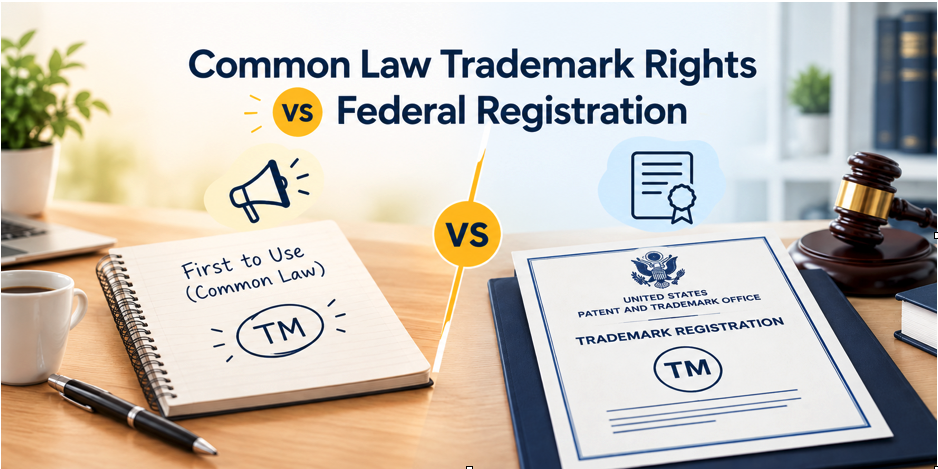
Common Law Trademark Rights vs Federal Registration
The primary difference between common law rights and federal registration is the scope and strength of the protection available to the trademark owner.
| Factor | Common Law Trademark Rights | Federal Trademark Registration |
| How Rights Arise | Generally arise through actual and continuous use of a trademark in commerce. | Established through successful registration of the trademark with the USPTO. |
| Registration Requirement | Federal registration is not required to establish common law rights. | Requires filing an application with the USPTO and completing the registration process. |
| Geographic Protection | Generally limited to the geographic area where the mark is used and goodwill is established, along with certain related expansion rights. | Generally provides nationwide protection for the registered goods or services, subject to prior rights and other legal limitations. |
| Legal Protection and Enforcement | Enforcement may be more challenging because the owner may need to prove use, priority, geographic scope, and consumer recognition. | Provides stronger federal enforcement advantages and important legal presumptions regarding ownership and exclusive rights. |
| USPTO Database and Public Notice | The mark does not receive a federal registration and generally will not appear as a registered trademark in the USPTO database. | The registration is recorded in the USPTO database, providing public notice of the owner's trademark claim. |
| Registration Benefits and Symbol | The owner may generally use the ™ symbol to indicate a claim of trademark rights, subject to applicable law. | The owner may use the ® symbol after federal registration, subject to applicable requirements and limitations. |
| Business Growth and International Strategy | May provide limited advantages for businesses operating within an established local or regional market and offers limited benefits for international trademark strategies by itself. | Can support national brand expansion, licensing and franchising, and certain international trademark filing strategies. |
Enforcement of Common Law Rights
A business with common law trademark rights can take action if another business uses a confusingly similar mark.
Possible steps may include:
- Contacting the other business.
- Sending a cease-and-desist letter.
- Negotiating an agreement.
- Taking action under applicable state or federal law.
- Filing a lawsuit when appropriate.
However, enforcing common law rights may require the business to prove when it started using the mark and the geographic area where it has established rights.
Enforcement of Federal Trademark Rights
Federal registration can make trademark enforcement easier and stronger in many situations.
A federal registration can provide important legal advantages, including:
- Evidence of ownership.
- A presumption of certain trademark rights.
- Nationwide constructive notice of the registration.
- Access to federal trademark enforcement options.
- Potential access to certain enhanced remedies.
- The ability to use the ® symbol after registration.
These benefits can be valuable when a business's trademark becomes an important part of its brand.
Benefits of Common Law Trademark Rights
Common law rights can offer several benefits.
1. No Federal Application Required
A business is not required to go through the federal registration process to begin the creation of its rights via usage.
2. Useful for Local Businesses
Common law rights can be valuable to those businesses which function primarily in one particular local market.
3. Protection Through Actual Use
The use of a trademark in your business will assist you in the formation of rights as well as customer recognition.
4. Lower Initial Cost
There is no filing fee at the USPTO just for creating common law rights through usage.
Limitations of Common Law Trademark Rights
Common law trademark rights provide protection through actual use but have certain limitations.
Limited Geographic Protection
Rights normally apply to the market where the trademark has been registered and its goodwill has been developed.
Harder to Prove
Sometimes, there may be the requirement for evidence showing the first use of the trademark.
No Federal Registration Benefits
Unregistered trademarks cannot have the added benefits that come with federal registration.
Expansion Challenges
Market expansion may prove problematic if similar marks enjoy existing legal protection in that market.
Less Public Visibility
Trademarks that are unregistered do not normally show up in the USPTO records as federally registered marks.
Benefits of Federal Trademark Registration
Federal trademark registration provides several important advantages for businesses seeking stronger brand protection.
1. Broader Protection
Registration results in protection throughout the United States for the products or services covered by the mark.
2. Stronger Legal Position
Registration offers certain presumptions that relate to trademark ownership and rights.
3. Public Notice
A registered trademark is found in the USPTO records, and it makes it easier to recognize the owner's claims.
4. Supports Business Expansion
Federal registration is of great benefit to companies that plan on expanding into several states.
5. Use of the ® Symbol
Once registration occurs, the owner will be able to use the ® symbol in relation to the trademark.
6. Stronger Enforcement
Registration gives access to further means of enforcement by the federal government as well as legal recourse.
7. Builds Brand Value
Trademark registration can become a significant business asset that will help in licensing, franchising, investments, and other developments.
Limitations of Federal Registration
Federal registration is powerful, but it does not provide unlimited protection.
A business must continue to meet applicable legal requirements and maintain its registration.
Some important points include:
- Registration only covers the goods and services listed in the registration.
- Earlier trademark rights may still affect the registered owner's rights.
- The trademark generally needs to remain in qualifying use.
- Required maintenance filings must be completed.
- A registration can be challenged in certain circumstances.
- The owner must monitor and enforce its rights.
Therefore, registration is not the end of trademark protection. Businesses should continue monitoring their trademarks after registration.
Conclusion
The common law trademark protection and the federal registration are both important ways for companies to safeguard their trademarks, but they provide different levels of safeguards. Traditionally, the common law trademark rights are based on use and are geographically confined to the location where the trademark was established, whereas the federal registration offers more extensive protections.
For those who intend to grow their business, the federal trademark registration could offer a number of significant advantages, including national scope, notice, presumption of ownership and exclusive rights, among others. Conducting a trademark search, selecting a trademark, documenting usage of the trademark and considering the option of registering the trademark federally would be beneficial.
RELATED Blog



comments